The next billion-dollar one-person company, and the permanent underclass
A one-person billion-dollar company and a permanent underclass are one forecast, seen from both ends. Our position, the evidence, and what we do about it.
In short
- Sam Altman has predicted a one-person billion-dollar company, while many in the AI industry expect a permanent underclass. We think these are one forecast, seen from opposite ends of the same distribution.
- The evidence that AI can do skilled work is strong: in the 2026 AI Index, software engineering and computer use climbed from far below the human baseline to near it within a single year.
- We believe a class that cannot climb is the default outcome within fifteen years at most, because entry-level work goes first and the best models are unlikely to stay cheap.
- A default is not a destiny. How the gains from AI are shared is a policy choice, and for a person the answer is ownership, not a race against a countdown.
Sam Altman said it out loud: AI will enable one-person billion-dollar companies. Not someday. Soon. In a 2024 conversation with Alexis Ohanian, reported by Fortune, he described a betting pool among technology chief executives on “the first year that there is a one-person billion-dollar company”.
We keep going back and forth on whether that is a genuine prediction or a very well-timed one to make when you are selling the infrastructure.
A second forecast is going around the same industry, and it is darker. It usually comes as a countdown: you have eighteen months to escape the permanent underclass. In April, Jasmine Sun’s reported essay in The New York Times showed how far the idea has spread among the people who build AI. It opens with this sentence:
Most people I know in the A.I. industry think the median person is screwed, and they have no idea what to do about it.
This paper sets out our position on both forecasts. In short: they are the same forecast, seen from opposite ends of one distribution. We believe it. And we believe it is still a choice.
One forecast, two tails
The careful version of the argument predates the countdown. Rudolf Laine’s essay By default, capital will matter more than ever after AGI and The Intelligence Curse, written with Luke Drago, set it out. When machines can do skilled work, the value of a person’s labour falls and the value of owning the machines rises. For most people in history, work has been the only ladder.
Now read Altman’s bet in that light. A company worth a billion dollars with one person in it is a company that no longer needs the thousands of people it would once have employed. The one-person billion-dollar company and the permanent underclass are not rival predictions. They are the two tails of the same curve.
Statisticians learn early that an average can rise while most people fall behind. Gains from software follow a power law: a few winners take most of the value. AI can raise total output enormously and still leave the median worker with a smaller share than before. Labour’s share of income in many rich economies has been drifting down for decades, and this technology pushes in the same direction, faster. The one-person billion-dollar company is the far tail. The underclass is the median. That is why the sentence in the Times names the median person: it is the right statistic, and the one most often missing from the headline numbers.
The evidence
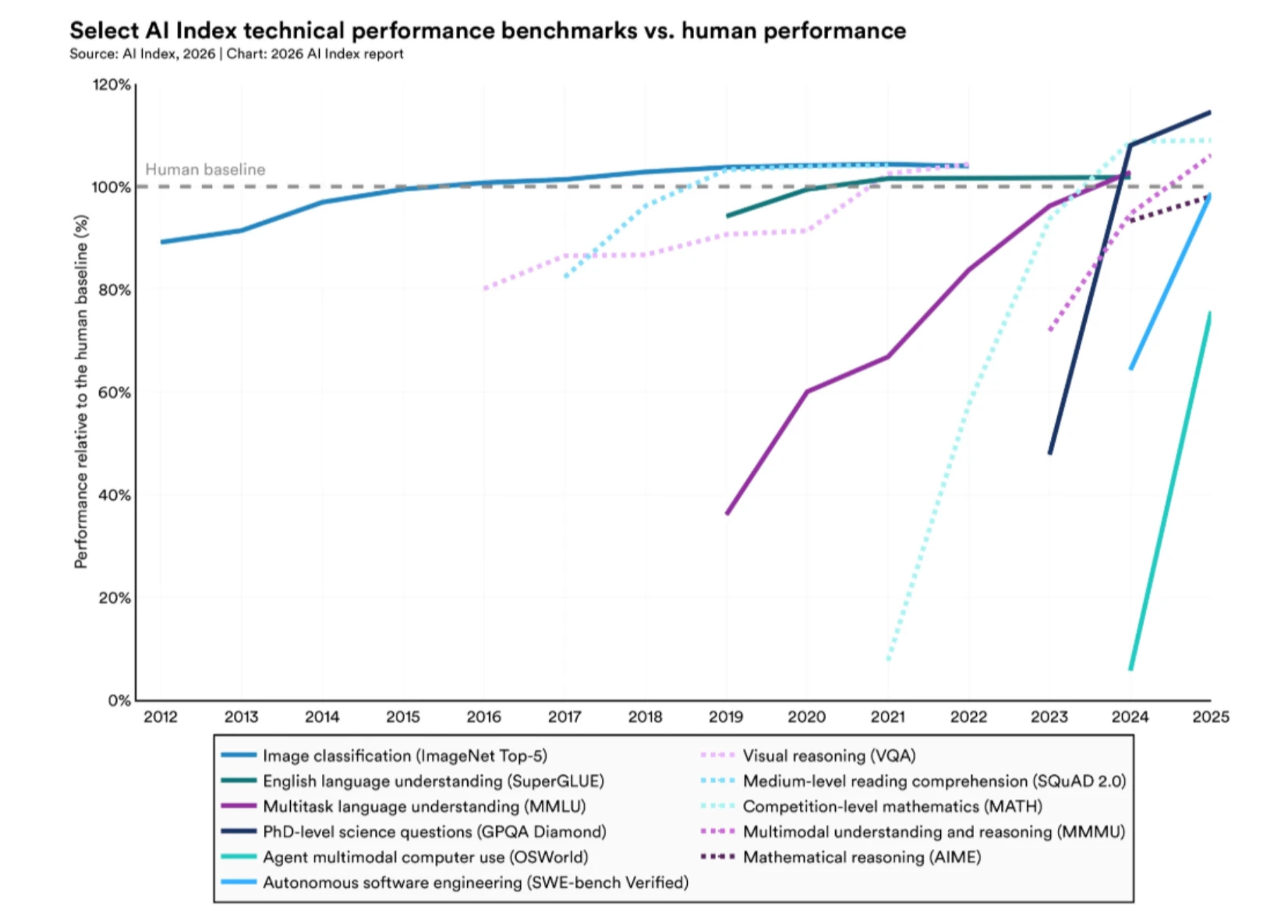
Every year the Stanford AI Index compares the best models with a human baseline on a set of benchmarks. The dashed line at 100% is the human. What matters is not that the lines cross it. It is how fast they cross it, and how that speed keeps rising.
Image classification took about three years to climb from 90% of the human baseline to parity, from 2012 to 2015. Multitask language understanding took about five, from 2019 to 2024. PhD-level science questions went from under half of the expert baseline to above it in a single year. Autonomous software engineering went from about 65% to nearly 100% in one year. Computer use, an agent operating a desktop the way a person does, went from single digits to about three quarters, also in one year.
We know the objections, because we would raise them ourselves. The benchmarks are selected, and the ones that get solved are the ones that end up in charts like this. “Human baseline” means different people on different tests, from crowd workers to domain experts. Test questions leak into training data. And a benchmark is not a job. All of this is true, and none of it explains away the newest lines. The early benchmarks measured seeing and reading. The newest measure work: writing software and operating a computer. Those are the lines with the steepest slopes, and they are the ones that matter for wages.
The chart also stops in 2025. Today, a model that leads the public rankings is often overtaken within weeks.
Adoption is no longer slow
The strongest comfort used to be diffusion. Electricity took decades to change factories, because the factories had to be rebuilt around it. AI was supposed to be the same: capable in the lab, slow to reach real work.
Look at how fast the industry agreed on the plumbing. Anthropic published the Model Context Protocol, an open standard for connecting models to tools and data, in November 2024. Within months its rivals had adopted it, and thirteen months after launch it was handed to a new Linux Foundation body, with OpenAI, Google, Microsoft and AWS among its backers. Competitors do not agree on a standard that quickly unless they expect to need it. The link between the model and the systems where work actually happens is being built at the speed of software, not the speed of factories.
There is no next room
The usual reply is history. In 1930 Keynes warned of “technological unemployment”. In 1964 a group of scientists and economists sent President Johnson a memo, The Triple Revolution, predicting a permanent class with no work to do. Both were wrong, because people kept moving into new kinds of work.
But look at where they moved. Machines took the work of muscle, so people moved into routine thinking. Computers took routine thinking, so people moved into judgement, language, analysis and care. Every wave left a room the machines could not enter. This wave is aimed at that room itself. When the tool can read, write, reason and plan, there is no obvious next room. The economist Wassily Leontief made the comparison decades ago: the horse was not retrained when the tractor arrived. Its work simply ended.
“It never happened before” is a base rate. Base rates are useful until the mechanism changes, and this time the mechanism has changed.
Cheap to build is not easy to climb
The hopeful view says the tools are rented by the month, at the same price for a student in Istanbul as for a fund in London, so everyone gets the same leverage. We are an independent studio led by a solo founder, so we see that leverage at first hand. Work that once needed a team, a budget and a year can now be done by very few people.
That is good news for the few. It is not good news for the team that was never hired. And when everyone can build, building stops being scarce. What stays scarce is what no subscription provides: an audience, distribution, a brand people already trust, data, and the capital to wait while something finds its market. Those belong to whoever already has them. Building has become cheap. Being found has not.
The bottom rungs go first
Mobility is not about the top of the ladder. It is about the bottom. Entry-level roles are where people learned a trade while being paid for it: the junior developer, the trainee analyst, the assistant who became the manager. That is exactly the work the new tools do best, and it is the first work that stops being hired.
A ladder with its lower rungs missing still has a top. The people already on it are fine. Nobody new gets on. Do that for a generation and the result looks permanent, even though no single decision made it so.
Cheap is a phase
Technology usually gets cheaper after it arrives, and AI seems to follow the rule: last year’s capability now costs a fraction of what it did. But last year’s capability is not what does the work. The frontier does, and the frontier has not become cheap. We read today’s prices as a land grab. The largest labs are reported to be losing billions of dollars a year, paid for by investors who expect that money back.
Watch what the labs are doing with it. They are no longer only selling tools. They are buying companies: by the spring of 2026, OpenAI alone had made almost as many acquisitions as in the whole of 2025, in developer tools, testing, health and finance, and its rivals are doing the same. They are building products that do the work themselves, not products that help someone else do it.
When a lab sells the work, the small builder is no longer its customer. They are its competition, and there is little reason to keep the best intelligence cheap for a competitor. Today the student in Istanbul and the fund in London pay the same price. We do not expect that to last.
Seen from here, the one-person billion-dollar company is also a sales message. The seller of the infrastructure tells every buyer that they could be the one. A few will be. Most will be paying the rent, and the rent is set by the seller.
Our position
- The permanent underclass is the default outcome. By our estimate it forms within fifteen years at the most. Fifteen years is shorter than a working life: a child starting school today will look for a first job inside it.
- The one-person billion-dollar company will happen. It will be rare, and it will be built on rented intelligence for as long as the rent stays low.
- A default is not a destiny. Sun’s conclusion is ours too: the production of a social underclass is a policy choice. A choice can be argued with, voted on and refused. A countdown cannot.
- Ownership beats wages. Wages are what the machines compete with. Ownership is what they work for.
What we do about it
We own what we make: our apps, our brand and our relationship with the people who use them. We build while building is cheap, because the tools that threaten the job are, for now, the same tools that let a small studio make something of its own. We put our name to everything we ship, because trust is what stays scarce when anyone can produce anything; the code we work by is on our philosophy page. And we say all of this out loud, because the choice is still open.
The countdown is wrong about one thing. There is no single moment when the door closes. It closes over years, not months, one unhired junior at a time. That is the bad news. The good news is that a door that closes slowly can still be held open.
Questions
What is the permanent underclass?
A term used in the technology industry for a possible future in which AI does most paid work, wages stop being a way up, and people without capital or a foothold stay where they are for good.
Did Sam Altman predict a one-person billion-dollar company?
Yes. In a 2024 conversation with Alexis Ohanian, reported by Fortune, he described a betting pool among technology chief executives on the first year there would be a one-person billion-dollar company, and said it would happen.
How quickly is AI reaching human-level performance?
Faster with each generation of benchmarks. In the 2026 AI Index, image classification took about three years to reach the human baseline and language understanding about five, while software engineering and computer use rose most of the way in a single year.
Will AI keep getting cheaper?
Older capability keeps getting cheaper. We do not expect the same of the best models, which do the most valuable work, once the current race for market share ends.
When does Commercium expect a permanent underclass?
Our estimate is fifteen years at the most. It will not arrive on a single day. It forms gradually, as entry-level roles stop being hired.
What should a person do about it?
Own something: a product, a share, a body of work or an audience. Learn to direct the new tools while they are cheap, earn trust, and take part in the public argument about how the gains are shared.


